English


Views: 0 Author: Site Editor Publish Time: 2026-10-01 Origin: Site


Managing a commercial aquatic facility requires delivering perfect water conditions every single day. Facility managers, hotel operators, and aquatic center directors know guest satisfaction hinges on reliable water temperatures. Commercial pools face unique thermal dynamics compared to residential setups. Bather loads fluctuate wildly, and health codes demand strict adherence to specific temperature ranges. Selecting the right heating equipment balances upfront capital expenditure and long-term operational costs.
Undersizing your equipment leads to missed temperature targets and immediate facility complaints. Conversely, oversizing unnecessarily inflates initial equipment expenses and demands costly electrical infrastructure upgrades. You need a clear, evidence-based framework to evaluate capacity requirements. We will explore core sizing formulas, environmental variables, and equipment configurations. This guide prepares you to assess heating needs accurately before engaging a mechanical engineer or supplier.
Commercial pool heating is dictated by surface area and required temperature rise (Delta T), not just total water volume.
A baseline calculation (Surface Area × Delta T × 12) provides a starting BTU requirement, but local climate and wind exposure can alter actual needs by up to 30%.
Commercial facilities often benefit more from multi-unit cascading heat pump systems rather than single massive units to ensure redundancy and operational efficiency.
Thermal pool covers are the single most effective variable for reducing required heat pump capacity and operational energy waste.
Determining the right swimming pool heat pump capacity is a critical engineering decision. Errors in this phase create cascading financial and operational problems. Facilities often struggle when they rely on guesswork instead of mathematical heat loss calculations.
An undersized unit creates a severe performance gap. It fails to maintain health-code or comfort-standard temperatures during shoulder seasons. Unexpected cold snaps will quickly overpower the system. The equipment then runs continuously to compensate. This 100% duty cycle accelerates compressor wear. The constant mechanical strain drastically shortens the overall asset lifespan, forcing early replacements.
Many operators assume bigger is always better. This mindset creates an expensive capital expenditure (CAPEX) trap. Oversized units require a massive initial investment. They also frequently trigger expensive electrical infrastructure upgrades. You might need new transformers or upgraded three-phase power panels just to support the excessive amperage draw.
Furthermore, an oversized unit suffers from short-cycling. It reaches the target temperature too quickly and shuts off. It then turns back on moments later when the water cools slightly. This rapid on-and-off cycling degrades system components over time. Contactors, capacitors, and compressors fail prematurely under these conditions.
A correctly sized commercial system achieves balance. It maintains a stable set point during the coldest expected month of operation. It runs at a reasonable duty cycle, optimizing energy draw while preserving mechanical longevity. Achieving this balance protects your budget and keeps swimmers comfortable.
Properly calculating the right swimming pool heat pump size requires understanding two fundamental metrics. You must abandon the common misconception regarding water volume and focus on evaporation.
Heat loss occurs primarily at the water's surface. Evaporation drives this energy loss. Total water volume in gallons dictates how long it takes to heat up initially. However, surface area dictates the continuous BTU capacity required to maintain that heat. A deep diving pool and a shallow wading pool of the same surface area lose heat at the exact same rate. Therefore, sizing formulas always start by measuring the square footage of the water surface.
Delta T represents the difference between two critical temperatures. You calculate it by subtracting the average air temperature of your coldest operational month from your target water temperature. Different facilities require different baseline temperatures. A competitive lap pool operates much cooler than a resort leisure pool.
Table 1: Common Commercial Pool Target Temperatures
Facility Type | Target Water Temperature (°F) | Typical Application |
|---|---|---|
Competitive Swimming | 78°F - 82°F | Olympic pools, high school athletics |
Recreational/Resort | 84°F - 86°F | Hotels, water parks, country clubs |
Therapy/Rehabilitation | 90°F - 94°F | Physical therapy clinics, senior centers |
You can determine your raw BTU requirement using a standard industry formula.
Formula: Pool Area (sq. ft.) × Delta T × 12 = Required BTUs per hour.
This equation provides a raw baseline. It assumes standard environmental conditions. It does not account for site-specific thermal losses. You must adjust this baseline number based on the physical environment surrounding your pool.
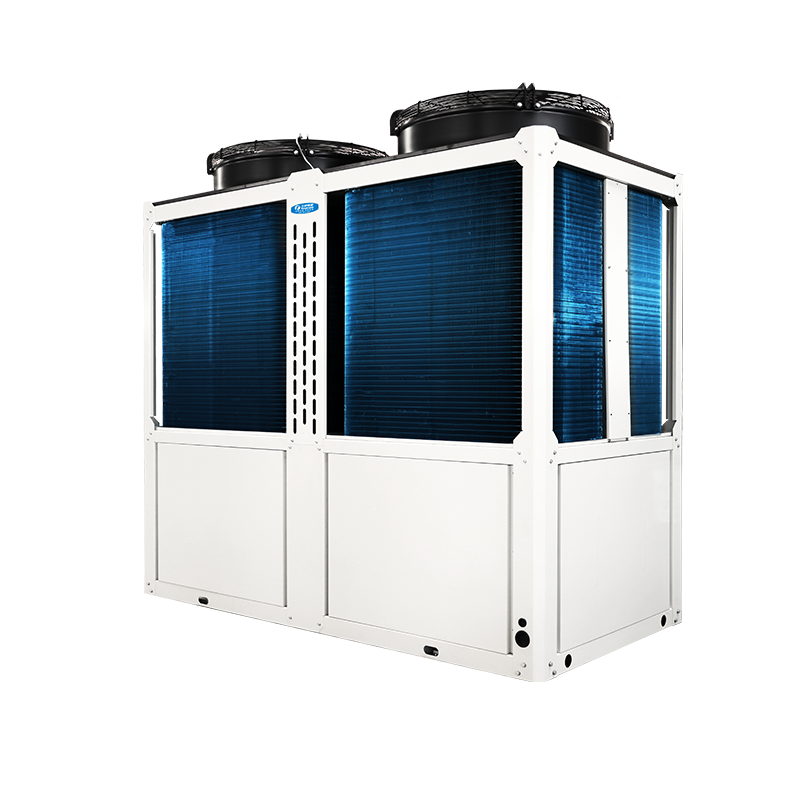
Calculations on paper often fail in the real world. Environmental conditions heavily influence actual heating performance. You must audit these external variables before finalizing your equipment selection.
Standard calculations assume gentle wind speeds of 3 to 5 mph. Pools located in open commercial spaces face higher winds. Coastal areas also experience constant breezes. Wind acts as a massive heat thief. It continuously strips away the thin boundary layer of warm, humid air resting above the water. This accelerates evaporative cooling exponentially. Facilities in windy areas require a significantly higher BTU multiplier to overcome this loss.
Heat pumps do not generate heat directly. They extract ambient heat from the surrounding air. Humidity plays a massive role in this thermodynamic process. High ambient humidity improves heat transfer efficiency. Moisture-laden air holds more thermal energy, resulting in a higher Coefficient of Performance (COP). Conversely, arid climates drastically reduce efficiency. Dry desert air forces the equipment to work harder. Facilities in arid zones often necessitate larger units or supplemental backup heating systems.
Indoor aquatic centers present unique engineering challenges. You cannot simply install a standard heater and walk away. Indoor pools require complex dehumidification integration. The equipment sizing must perfectly align with the building's HVAC system. If you heat the water without managing the resulting air moisture, you will cause severe structural damage. Condensation will ruin walls, ceilings, and ductwork.
Implementing an automated commercial pool cover alters the entire sizing model. Uncovered pools bleed energy overnight. Deploying a thermal cover during off-hours can reduce your BTU requirements by up to 50%. It traps the heat and stops evaporation entirely.
Measure average wind speeds at the specific equipment pad location.
Review historical weather data for your coldest operational month.
Assess natural windbreaks like buildings, fences, or dense landscaping.
Mandate thermal cover usage in facility operating procedures to guarantee energy savings.
Once you determine the required capacity, you must decide how to deliver those BTUs. Choosing the right equipment architecture is just as important as the raw mathematical sizing. You should consult a reputable swimming pool heat pump manufacturer to explore these configurations.
Some facilities opt for one massive unit to handle the entire heating load.
Best for: Medium-sized hotel pools possessing limited equipment pad space.
Pros: This setup allows for easier initial plumbing. It only requires a single electrical run, simplifying installation.
Cons: It creates a single point of failure. If the compressor breaks, the pool immediately goes cold. Massive units also operate less efficiently when trying to maintain minor temperature corrections during low-demand periods.
Modern aquatic engineering strongly favors modular designs for larger facilities.
Best for: Large aquatic centers, Olympic-sized pools, and high-end resorts.
Concept: You link multiple smaller commercial units together. For example, you might install three 140,000 BTU units instead of one massive 400,000 BTU unit. They communicate through a central controller.
Pros: This system offers built-in redundancy. Scalable operation saves massive amounts of energy. Only one unit runs to maintain the heat on a sunny day. All units run simultaneously to aggressively raise the heat after a cold snap. Furthermore, smaller units utilize standard commercial parts. This makes them much easier and cheaper to repair.
Table 2: Single-Unit vs. Cascading System Comparison
Feature | Single Large Unit | Cascading Multi-Unit System |
|---|---|---|
Redundancy | None (Single point of failure) | High (If one fails, others keep running) |
Energy Efficiency | Moderate (Prone to short-cycling) | Excellent (Stages output based on demand) |
Installation Space | Minimal pad space required | Requires extended equipment pad |
Maintenance Cost | High (Specialized heavy commercial parts) | Lower (Standardized components) |
Theoretical sizing means nothing if your facility cannot physically support the equipment. Many projects stall during installation because managers ignore site constraints. You must evaluate your infrastructure before purchasing any hardware.
Before committing to a specific capacity, verify your electrical panel. Commercial heaters draw substantial power. They often require 208-230V or 460V 3-phase power. Check your available breaker space and total service ampacity. Upgrading a commercial electrical panel can add thousands of dollars to your project. Identifying electrical limits early helps you select equipment appropriately.
These units require massive volumes of ambient air to function. Equipment pads must allow for manufacturer-specified clearances. You typically need 24+ inches of clearance around the entire perimeter. You also need completely unrestricted overhead space. If you tuck the unit under a low roof or tight enclosure, it will choke. The unit will recirculate its own cold exhaust air. This creates a freezing microclimate around the evaporator coil, destroying operational efficiency and causing constant defrost cycles.
Calculate your baseline BTU requirement using accurate surface area measurements and your target Delta T.
Audit your site’s wind exposure, shading, and historical humidity levels to establish a realistic BTU multiplier.
Verify your facility's available electrical service panel capacity.
Consult with a commercial aquatic engineer or specialized distributor to finalize a heat loss analysis and select the optimal cascading or single-unit configuration.
Determining the correct heating capacity for a commercial aquatic facility requires precise engineering calculations. Guesswork leads to disastrous operational outcomes and unhappy guests. You must accurately assess your pool's surface area, target temperature rise, and local environmental variables.
A strategic choice between single or multi-unit cascading systems will protect your facility's bottom line. Modular systems offer the redundancy and efficiency required for modern high-demand operations. Always evaluate your electrical infrastructure and pad clearance before finalizing any purchase. Contact a specialized commercial sales team or engineering support group today for a customized thermal audit. Securing a precise BTU sizing recommendation guarantees year-round comfort and mechanical reliability.
A: It varies entirely based on surface area and climate, but commercial applications typically start at 140,000 BTUs and often require cascading systems exceeding 500,000+ BTUs combined.
A: Standard models lose efficiency below 50°F. Facilities operating in freezing climates require commercial units with active defrost capabilities or must use gas heaters as primary/hybrid heat sources.
A: For commercial pools in extreme summer climates (e.g., Texas, Florida, Arizona), a heat/cool pump is vital to prevent water from exceeding health code limits or becoming uncomfortably warm for competitive swimming.
A: A properly utilized cover reduces evaporative heat loss by up to 80% overnight, allowing facilities to successfully use smaller, more energy-efficient heat pumps than an uncovered pool would require.


